Measure redox potential in microenvironments
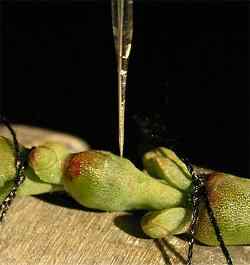
With the tip size down to 10 µm, less than 5 seconds in response time, and 1 mV in resolution, the Unisense Redox microsensor offers a high quality research tool for reliable and fast measurements.
The microsensor construction makes it possible to use the Redox microsensor in a broad variety of research fields where non-destructive, fast and accurate measurements are required. The redox microelectrode is designed for research applications within:
- Environmental sciences
- Biomedical sciences
- Biotechnology
- Microbiology
Microelectrode technology:
The Redox electrode tip will develop an electrical potential relative to the reference electrode when both electrodes are immersed in the same solution and connected to a high-impedance millivolt-meter e.g. the Unisense pH/mV-Meter. This potential reflects the tendency of the solution to release or take up electrons; also called the Oxidation-Reduction Potential (ORP). The Unisense Redox microelectrode can be used for measurements in salinities from 0 to full ocean strength.
Ordering Information
| Standard Glass Sensor |
Outside tip diameter |
| RD-10 |
8-12 µm |
| RD-25 |
20-30 µm |
| RD-50 |
40-60 µm |
| RD-100 |
90-110 µm |
| RD-500 |
400-600 µm |
| RD-MR |
400-600 µm |
| RD-N |
1,1 mm |
| RD-Eddy |
15-25 µm |
Find a complete list of redox microsensor specifications below and possible microeletrode customizations and adaptations under Related Products found to the right.

 400-878-1895