Background
When using the previous generation of Train Management Systems, manufacturers and operators had to build separate networks for different services. For example the CCTV (Close Circuit Television) had one network and the PIS (Passenger Information System) had another one. This previous technology is still suitable for some particular projects, but to build and support several networks is complicated and more expensive from a hardware and software perspective. In addition, many of the traditional train network standards did not have the bandwidth to support multiple services. Fortunately, with the current trend Ethernet and IP-technology, this will radically change.
Ethernet and IP will help making trains smarter and more cost-efficient. By using Ethernet as the backbone, train manufacturers and/or operators can use a single network to connect all devices and subsystems. This means a much simpler and manageable network and consequently it is more cost effective to operate. The train IP network can also be part of a larger train-to-wayside communication network.
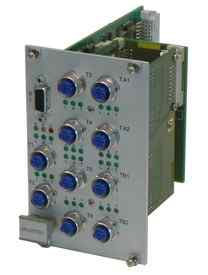
The Ethernet Router Unit (ERU) is a combination of Ethernet Router and Switch functionalities that integrate seamlessly into the EKE-Trainnet® Train Communication and Management System (TCMS). The ERU module is designed to offer a high degree of versatility and modularity providing great solutions adapted to every customer and project. ERU’s wide range of features makes this unit ideal for today's demanding customer requirements.
The Ethernet Router routes traffic between Ethernet Train Backbone (ETB) and Ethernet Consist Network (ECN). These networks are used for sending any information along the length of the train, including CCTV footage, control commands and train diagnostics. Currently the ERU supports up to 1 Gbps networks for ETB.
EKE Ethernet Router fully complies with coming IEC61375 standard for Ethernet Train Bus.
Inauguration
Train inauguration has been possible with WTB. WTB is reliable but the bandwidth is limited. This meant that if other services were needed, additional separate networks had to be built which resulted in additional costs. With the new ERU, inauguration is part of the single network.
ERU module handles the train inauguration as cars are connected together and disconnected, and provides this information to any onboard subsystem application. The ERU module includes an ECN Switch, which provides connectivity to consist network switches in a ring configuration, or directly to end-devices. The switch provides services such as DHCP in order to assign IP addresses to end-devices automatically. Powering up the train TCMS will start the distribution of localized train subnet IP addresses for the local Car’s End Units.
ERU module optionally provides other functionalities such as: Event logger, communication with IO modules and communication with non-Ethernet Consist Network Interface modules (e.g. MVB, CVB). It can also provide a gateway to WTB network.
Benefits
The Ethernet Routers offer many benefits to train operators by making trains more efficient to build and operate:
Automatic inauguration
Usage of the fleet becomes more efficient as trains now inaugurate automatically when the consist is changed.
Bandwidth improvement
As Ethernet provides a huge improvement in bandwidth, all data (voice, pictures, video, diagnostics and control data etc.) within the train can be transferred using the same Ethernet network. There is no need to build costly separate communication networks anymore.
Reliability
The car can be equipped with two redundant ERU modules to increase system reliability. In case that the principal module fails, the secondary module takes over the functionality. In addition, ERU module has bypassing functionality which allows the information to go through even if the car is unpowered.
Technical Information
- The Routers have the size of 3U 16TE and they fit into EKE-Trainnet® system racks from the compact 44TE to 19” 6U racks.
- The Router is powered by reliable EKE PSU rack power supply unit and it communicates with the rest of the rack equipment (such as CPUs, WTB, MVB, CAN or I/O) via rack internal VME bus.
- Eight Ethernet ports are equipped with 100Mbps M12 connectors, and further two ports can be either 100Mbps copper or 1Gbps optical.
- Four of the 100Mbps ports provide Ethernet Train Backbone (ETB) connectivity and by-pass functionality when acting as an Ethernet Train Backbone Node (ETBN).

 400-878-1895